
Why do golfers commonly develop wrist pain?
Although golf is often considered low impact, wrist and hand injuries are among the most common musculoskeletal problems affecting golfers. The golf swing generates high-speed rotation, rapid acceleration, and sudden deceleration through the hands and wrists. These forces place substantial stress on small joint structures, particularly at impact and during ground-first contact.
Many golfers are surprised to learn their pain is not “just a sprain,” but often involves specific tissues that are repeatedly loaded throughout the swing.
Which wrist is usually injured in golf?
The leading wrist (left wrist in right-handed golfers) is most often affected. The majority of golf-related wrist injuries occur on the ulnar side (little-finger side), which absorbs high rotational and compressive forces during the downswing and impact phases.
What structures are most commonly injured?
The most frequently involved structures include:
- Triangular fibrocartilage complex (TFCC)
- Extensor carpi ulnaris (ECU) tendon
Other golf-related wrist conditions may include:
- Hook of hamate fractures
- De Quervain’s tenosynovitis
- Ulnar or median nerve compression
- Tendon overload and grip-related injuries
How do golf wrist injuries usually happen?
Golf wrist injuries typically develop through either:
Sudden impact
- “Hitting it fat”
- Striking roots, rocks, or hard surfaces
- Sudden club deceleration
Repetitive overload
- High-volume practice
- Prolonged mat sessions
- Sustained gripping forces
- Rapid increases in playing load
These mechanisms expose the wrist to torsional stress, shear forces, and vibration, particularly on the ulnar side.
What symptoms should golfers look out for?
Common warning signs include:
- Ulnar-sided wrist pain
- Clicking, catching, or a sense of instability
- Pain at impact or with twisting
- Reduced grip strength
- Localised swelling or tenderness
Wrist symptoms that persist, worsen, or interfere with performance should be assessed early.
How are golf-related wrist injuries assessed?
Assessment begins with a detailed golf-specific history, including:
- Hand dominance
- Playing and practice volume
- Recent equipment or swing changes
- Mechanism of symptom onset
Clinical examination may assess wrist stability, tendon behaviour, grip tolerance, and nerve involvement. Imaging such as MRI, ultrasound, CT, or specialised X-ray views may be used when structural injury is suspected.
What does hand therapy treatment involve?
Management usually focuses on early, functional rehabilitation rather than prolonged immobilisation.
Treatment may include:
- Load modification
- Adjusting practice volume, impact exposure, and swing demands
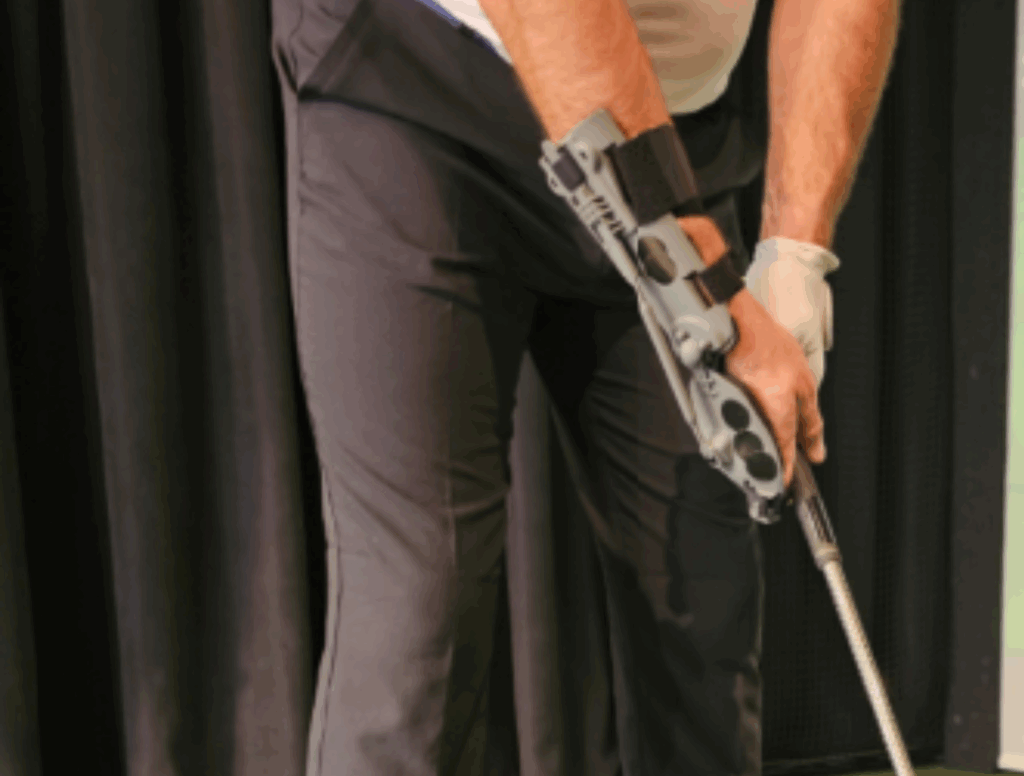
- Supportive bracing
- To offload sensitive wrist structures while maintaining movement
- Progressive strengthening
- Targeting wrist stabilisers, ECU, pronator quadratus, and grip endurance
- Proprioceptive retraining
- Improving coordination and joint control
- Graded return to play
- putting/chipping → partial shots → full swings → uneven ground
- Collaboration with golf professionals
- To address swing patterns that increase wrist stress
Do golfers need to stop playing completely?
In most cases, no. With appropriate load management and structured rehabilitation, many golfers can continue modified participation while recovering. The goal is usually adaptation rather than cessation.
How can golfers reduce their risk of wrist injury?
Equipment considerations
- Larger or cushioned grips
- Graphite shafts to reduce vibration
- Lower-compression golf balls
Biomechanical strategies
- Allowing lead heel lift
- Flaring the feet to improve trunk rotation
- Moderating backswing length
- Allowing trail foot release through impact
Training principles
- Gradual workload progression
- Limiting prolonged mat practice
- Regular wrist and forearm conditioning
- Early assessment of persistent symptoms
Is it safe to play through wrist pain?
Ongoing wrist pain is a sign of tissue overload. Playing through symptoms increases the risk of chronic injury and prolonged time away from the course. Early assessment supports faster and safer return to play.
Key Takeaways
- Wrist injuries are the most common golf-related musculoskeletal condition
- The leading wrist and ulnar side are most frequently affected
- TFCC and ECU injuries are especially prevalent
- Early, golf-specific hand therapy supports safe return to play
- Equipment, swing, and workload management are critical for prevention
References
- McCarroll JR, Retting AC, Shelbourne KD. (1990). Injuries in the amateur golfer. The Physician and Sportsmedicine, 18(4), 122–126.
- Hawkes, R., O’Connor, P., & Campbell, D. (2013). The prevalence, variety and impact of wrist problems in elite professional golfers on the European Tour. British Journal of Sports Medicine, 47(17), 1075–1079. https://doi.org/10.1136/bjsports-2012-091917
- Woo, S.-H., Lee, Y.-K., Kim, J.-M., Cheon, H.-J., & Chung, W. H. J. (2017). Hand and wrist injuries in golfers and their treatment. Hand Clinics, 33(1), 179–188. https://doi.org/10.1016/j.hcl.2016.08.012
- Williamson, T. R., Kay, R. S., Robinson, P. G., Murray, A. D., & Clement, N. D. (2024). Epidemiology of musculoskeletal injury in professional and amateur golfers: A systematic review and meta-analysis. British Journal of Sports Medicine, 58(11), 606–614. https://doi.org/10.1136/bjsports-2023-107324
By: Sam Jubber – Clinical Partner, Peninsula Hand Therapy (Mornington, VIC)